
Therapy for Imposter Syndrome UK: A Depth Psychology Approach to the Fraudulent Self

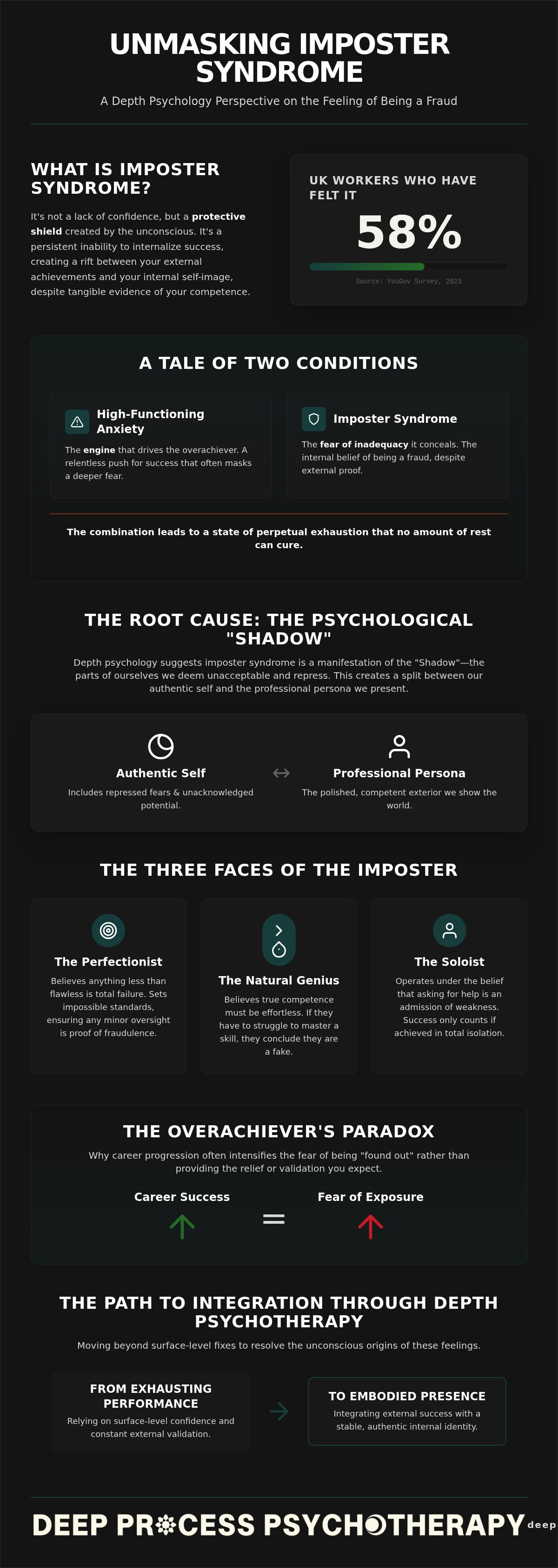
Imposter syndrome is not a lack of confidence, but a protective shield created by the unconscious to manage the weight of a perfect persona. You might have achieved every professional milestone set before you, yet the internal sensation of being a fraud remains stubbornly intact. Data from 2023 suggests that nearly 58% of UK workers experience these feelings, yet knowing you aren't alone rarely eases the individual burden of high-functioning anxiety. When seeking therapy for imposter syndrome UK practitioners often focus on surface-level confidence building, yet these methods rarely touch the deeper roots of the fraudulent self.
It's profoundly exhausting to maintain a perfect professional persona while waiting for the moment the mask finally slips. You likely understand the intellectual reality of your achievements, yet you cannot seem to internalise them as part of your true identity. This article explores how depth psychotherapy goes beyond quick fixes to resolve the unconscious origins of these feelings. We'll examine the process of integrating your professional success with your internal self-image, guiding you toward a quiet confidence that no longer requires constant validation to feel secure.
Key Takeaways
- Learn to distinguish between transient situational nerves and the chronic, internalised sense of fraudulence that characterizes the imposter phenomenon.
- Understand how the psychological "Shadow" leads you to project feelings of unworthiness onto your professional accomplishments, creating a rift between your status and your self-image.
- Discover why career progression often intensifies the fear of being "found out" rather than providing the relief or validation you expect.
- Explore how specialized therapy for imposter syndrome UK facilitates a shift from exhausting performance toward a grounded state of embodied presence.
- Uncover the path toward long-term transformation by integrating your external successes with a stable, authentic internal identity through depth psychotherapy.
Defining the Imposter Phenomenon in the UK Professional Landscape
Imposter syndrome represents a persistent, internalised inability to acknowledge one's own success. Despite tangible evidence of competence, many professionals in the UK corporate and creative sectors live with a haunting suspicion that they're merely playing a part. This is not a simple case of pre-presentation nerves. It is a chronic fraudulent self-image that persists regardless of external validation. It is a quiet, persistent dissonance; a shadow that follows the high achiever from the boardroom to the private sanctuary of the home. Research from a 2023 YouGov survey indicates that nearly 58% of UK workers have experienced these feelings. While common, the experience is deeply isolating. It suggests a fundamental rift between the individual's external achievements and their internal self-concept.
When individuals explore the history of Impostor Syndrome, they find it is less about a lack of skill and more about a profound psychological dissonance. It is a depth issue. It resides in the unconscious layers of the personality and cannot be resolved through mere confidence building. This internal friction is rooted in how we perceive our right to occupy space in the professional world. It requires a patient, reflective approach to uncover why the mind refuses to accept the reality of its own capabilities.
The Five Faces of the Imposter
The experience of being an imposter manifests in distinct archetypal patterns. These aren't just personality traits; they are protective mechanisms designed to manage the threat of exposure. The Perfectionist, for instance, believes that anything less than flawless is a total failure. They set impossible standards, ensuring that even a minor oversight becomes definitive proof of their fraudulence. For the Natural Genius, the shame lies in the act of trying. They believe that true competence must be effortless. If they have to struggle to master a skill, they conclude they're a fake. The Soloist operates under the belief that asking for help is an admission of weakness. To them, success only counts if achieved in total isolation; any support received contaminates the achievement.
Imposter Syndrome vs. High-Functioning Anxiety
Many people confuse this internal struggle with standard high-functioning anxiety. While they often coexist, they are distinct. High-functioning anxiety is often the engine that drives the overachiever, yet this relentless drive masks a deep-seated fear of inadequacy. Maintaining a professional mask takes a severe physical and psychological toll. It leads to a state of perpetual exhaustion that no amount of rest seems to cure. Traditional confidence coaching often fails here because it treats the symptom rather than the root. Seeking therapy for imposter syndrome UK offers a sanctuary to dismantle the mask. It's a process of moving beyond performing competence toward embodying presence, addressing the unconscious roots that surface-level strategies cannot reach.
The Shadow at Work: A Depth Psychology Perspective
Depth psychology suggests that what we call imposter syndrome is often a manifestation of the "Shadow." This concept refers to the parts of ourselves we deem unacceptable or "not-me." When we enter the workplace, we strive to present a polished, competent exterior. We project our unworthiness onto our professional achievements, convincing ourselves that our success is a mistake or a byproduct of luck. This split between the authentic self and the professional persona creates a sense of being an actor in one's own life; the mask becomes a prison that restricts our ability to feel seen. It is a heavy weight to carry, requiring constant vigilance to ensure the facade remains intact. While many discussions regarding imposter syndrome in the UK focus on cultural barriers, depth psychology looks at the internal landscape. We must ask what parts of our own potential we have relegated to the dark to maintain our current standing. The Shadow is the repository of all unacknowledged potential and repressed fear.
The Unconscious Roots of Fraudulence
Our relationship with success is often forged in early developmental stages. If validation was conditional on achievement, we might struggle to accept success as adults. We perceive it as a burden or a threat. The Inner Critic acts as a guardian of the Shadow, whispering that we don't belong whenever we reach a new level of visibility. This often leads to self-sabotage, such as missing deadlines or underpreparing for key meetings to prove our unworthiness and return to a state of internal safety. It's a way of protecting ourselves from the perceived danger of being truly seen. Engaging in 1:1 therapy for imposter syndrome UK allows for the careful dismantling of these defensive patterns, creating space for a more integrated self.
Projecting the "Expert" Onto Others
A common symptom of this rift is perceiving others as "real" experts. We see colleagues as grounded and capable while viewing ourselves as amateurs who've somehow fooled the system. This projection creates a wall, preventing genuine connection and making mentorship feel like a risk rather than an opportunity for growth. Many who seek therapy for imposter syndrome UK find that reclaiming authority through inner work is the key to seeing others as equally human, navigating their own complexities. This transition requires a space for serious reflection and a willingness to look behind the curtain of our own projections. Exploring The Shadow At Work provides a framework to move from performance to genuine authority.
The Overachiever’s Paradox: Why Success Fuels the Fear
It's a common misconception that professional validation serves as an antidote to self-doubt. You might believe that if you were truly capable, the anxiety would dissipate with every promotion or successful project. Yet, for many, the opposite occurs. Success doesn't soothe the fraudulent self; it raises the stakes. Every accolade or increase in responsibility heightens the perceived distance between your public image and your internal reality. This is the overachiever’s paradox. As you climb, you don't feel more secure. You feel more exposed. The height from which you fear falling increases, making the potential for exposure feel catastrophic rather than just a professional setback.
In high-pressure UK work cultures, this is often exacerbated by the moving goalpost phenomenon. Once a milestone is reached, the focus immediately shifts to the next objective, leaving no space to internalise the achievement. This environment is further complicated by tall poppy syndrome, a cultural tendency to resent or critique those who stand out. For the high achiever, being noticed is a double-edged sword. You want the success, but you fear the scrutiny that comes with it. This cultural backdrop makes seeking therapy for imposter syndrome UK a vital step in reconciling your public success with your private peace.
The Burden of Potential
The label of being gifted or high-potential often becomes a heavy mantle. When brilliance is expected, there is no room for the messy, iterative process of learning. You feel you must arrive fully formed. This pressure prevents the freedom to fail, which is essential for genuine growth. Instead, you perform competence while hiding the effort required to maintain it. This chronic performance is a primary driver of career burnout. When you can't afford to be a beginner, you eventually run out of the energy required to be an expert. Clinical descriptions of Imposter Syndrome highlight this cycle of over-preparation and subsequent exhaustion as a hallmark of the experience.
Success as a Threat to Identity
Achieving a long-held goal can paradoxically feel like a loss. There is a strange safety in the struggling self; the version of you that was always striving but hadn't yet arrived. When you finally reach the summit, that identity is threatened. You might also harbor an unconscious fear that your success will alienate you from peers or family who haven't reached similar heights. This internal conflict creates a ceiling on your professional growth. Understanding these deep-seated fears is a core component of the work, and it's often why overachievers benefit from long-term psychotherapy. By examining the identity shifts required by success, we can begin to integrate your achievements into a stable sense of self.
Beyond Confidence: How Psychotherapy Facilitates Integration
The journey toward psychological wholeness does not require the destruction of the imposter. It requires a patient inquiry into why this part of the self believes it must hide. Many approaches to therapy for imposter syndrome UK focus on building self-worth, yet this can inadvertently create a new, better mask to wear. Depth psychotherapy seeks to move beyond this performance. It invites the Shadow into the light of awareness, allowing the individual to inhabit their success without the constant fear of exposure. This long-term work provides a durability that short-term coaching cannot match, as it addresses the structural roots of the personality rather than just the behavioral symptoms.
True integration is not about attaining a state of permanent confidence. It's about shifting from performing competence to embodying presence. When you perform, you're constantly monitoring the audience's reaction. When you embody presence, you're grounded in the reality of your own experience. This shift allows the fraudulent self to step back, no longer needed as a shield against the perceived dangers of professional life. It's a process of bringing what was previously hidden into the light, where it can be understood and eventually integrated into a more resilient sense of self.
The Roadmap to Integration
Integration is a methodical process that unfolds through several developmental stages. It's not a linear path, but rather a deepening of self-awareness that allows for a more authentic way of being in the world. The following steps provide a framework for this inner work:
- Recognising the Fraud: Understanding the imposter not as a character flaw, but as a historical defense mechanism that once served a purpose.
- Dialogue with the Critic: Engaging with the Inner Critic through reflective dialogue rather than suppression, transforming a persecutory voice into one of discernment.
- Internalising Achievement: Consciously connecting success to your own effort and skill, rather than dismissing it as the result of luck or timing.
- The Good Enough Identity: Developing a professional self-image that allows for human error and learning without the threat of total identity collapse.
The Role of the Therapeutic Relationship
The core of this transformation is the therapeutic relationship itself. The chronic fear of being found out is often a projection of early experiences where vulnerability was met with judgment or indifference. In the therapy room, you're seen in your entirety. This experience acts as a corrective laboratory where authentic self-expression is met with empathy and clinical insight. A steady, intellectual presence provides the anchor needed to navigate these complex internal landscapes. To begin this process of deep inquiry, you may explore 1:1 Therapy as a sanctuary for your personal evolution.
Commencing Your Inner Work with Deep Process Psychotherapy
Deep Process Psychotherapy serves as a sanctuary for those navigating the complex internal landscapes of high achievement. It is a space designed for patient, serious reflection, where the fraudulent self is not judged but understood as a meaningful part of the psychological whole. For those seeking therapy for imposter syndrome UK, the practice offers a methodical bridge between high-level psychological theory and the practical reality of professional life. This is not a process of rapid correction or superficial behavioral hacks. It is an evolution of the individual, requiring a commitment to uncovering the unconscious roots of one's own self-doubt.
The work we undertake is grounded in the belief that professional success should not come at the cost of internal peace. By providing a stable anchor for those navigating profound emotional territory, the brand positions itself as a guide through the developmental transitions of the self. Whether through 1:1 engagement or collective exploration, the goal remains the same: the integration of your professional success with a stable, authentic internal identity.
1:1 Psychotherapy for Professionals
The core of the therapeutic process resides in 1:1 sessions, which provide the safety necessary for deep psychological processing. This tailored support is specifically crafted for high achievers and those navigating significant career transitions where the pressure to perform is at its peak. It is a thorough approach that respects the nuance of your personal history and the gravity of your current role. To begin this journey of self-discovery is to commit to a long-term integration of the self. By bringing clinical expertise to the nuances of your professional shadow, we facilitate a transition from high-functioning anxiety to a grounded, quiet confidence that no longer requires constant external validation.
Resources for Continued Growth
Beyond the therapy room, the practice provides frameworks for ongoing development and reflection. The Shadow At Work serves as a vital resource for those looking to bridge the gap between their internal states and their professional presence. This work requires patience and a willingness to engage with the parts of the self that are often ignored in the pursuit of success. For organisations ready to address these patterns collectively, corporate workshops offer a way to explore how systemic pressures and workplace cultures shape the individual experience of fraudulence.
Regular insights are also available through the Substack newsletter, providing a rhythmic reminder of the importance of the inner life. This methodical pace reinforces a commitment to a thorough, non-superficial approach to personal growth. If you are ready to move beyond the exhaustion of the professional mask, you may enquire about 1:1 therapy for imposter syndrome to begin your personal process of integration.
Embodying Authenticity in Professional Life
The persistent sensation of being a fraud is not a sign of failure, but an invitation to explore the unacknowledged layers of your own potential. We've seen that external validation cannot bridge the gap between a polished persona and an internal sense of unworthiness. True resolution requires a patient descent into the unconscious roots of these patterns. By integrating the Shadow and understanding the protective function of the fraudulent self, you move from the exhaustion of performance toward the stability of genuine presence. This evolution allows you to inhabit your achievements without the constant vigilance of the overachiever's paradox.
Deep Process Psychotherapy offers a specialized depth psychology approach to help you navigate these complex internal landscapes. With expertise in high-achiever burnout and the unique insights found in "The Shadow At Work," this practice serves as a steady anchor for your developmental journey. Choosing therapy for imposter syndrome UK is an act of reclamation, allowing you to align your external success with a grounded internal identity. You deserve a professional life that feels as substantial as the milestones you've reached. Begin your journey toward professional integration with 1:1 therapy and discover a way of being that no longer requires the mask of perfection.
Frequently Asked Questions
Is imposter syndrome a mental health diagnosis in the UK?
Imposter syndrome is not a formal clinical diagnosis within the UK healthcare system. It is classified as a psychological experience or pattern rather than a distinct mental disorder. While it does not appear in the DSM-5, it frequently co-occurs with clinical anxiety or depression. Many individuals seeking therapy for imposter syndrome UK find that their symptoms meet the criteria for high-functioning anxiety, even if the "imposter" element itself remains a descriptive term for their internal struggle.
How long does therapy for imposter syndrome usually take?
The duration of treatment depends on whether you seek surface-level coping strategies or deep structural change. Short-term interventions might last twelve to twenty weeks, focusing on immediate cognitive shifts. However, depth psychotherapy is a longer commitment, often spanning several months or years. This methodical pace allows for the uncovering of unconscious roots and the stable integration of the self. True transformation requires a patient's willingness to engage in a thorough, non-superficial process of personal evolution.
Can imposter syndrome ever be a "good thing" for my career?
While the drive to "prove yourself" can lead to high standards and meticulous work, it is rarely sustainable. This internal pressure often functions as an engine for overachievement, but the fuel is fear rather than genuine inspiration. Over time, the cost of this perceived benefit is professional burnout and chronic exhaustion. Relying on a fraudulent self-image to maintain your career trajectory creates a fragile foundation that eventually collapses under the weight of its own performance.
What is the difference between imposter syndrome and low self-esteem?
Low self-esteem is a global evaluation of one's worth across all areas of life. In contrast, imposter syndrome is specifically tied to competence and the inability to internalise success. You might feel generally confident in your personal life yet feel like a fraud in the boardroom. This specific dissonance between objective achievement and internal self-image is what distinguishes the imposter phenomenon from a broader lack of self-worth or general insecurity about one's value.
How do I know if I need therapy or just a career coach?
Career coaching typically focuses on external skills, strategic goals, and behavioral performance. If your struggle is rooted in deep-seated fears, childhood expectations, or a persistent sense of fraudulence despite your skills, therapy is the appropriate path. Therapy for imposter syndrome UK addresses the unconscious drivers that coaching cannot reach. When the mask of perfection feels like a prison rather than a professional tool, you require the clinical depth and philosophical inquiry found in psychotherapeutic engagement.
Can imposter syndrome return after successful therapy?
Psychological growth is rarely a linear journey toward a final destination. While the intense, paralyzing fear of being found out typically diminishes through integration, milder echoes may resurface during significant life transitions or new professional heights. The difference lies in your relationship with these thoughts. After thorough inner work, you possess the awareness to recognize the imposter as a historical defense rather than an absolute truth. You learn to lead from a grounded center rather than being driven by the shadow.
Does shadow work help with imposter syndrome at work?
Shadow work is an essential component in resolving the fraudulent self. It involves identifying the unacceptable parts of ourselves that we've repressed or projected onto others. By reclaiming these "not-me" elements, you reduce the internal split that fuels the feeling of being an actor. This process allows you to inhabit your professional role with a sense of wholeness. Integrating the shadow ensures that your success is no longer a threat to your internal safety but a natural extension of your self.
What should I look for in a therapist for imposter syndrome?
You should prioritize practitioners registered with professional bodies such as the BACP or UKCP. These organizations ensure ethical standards and ongoing clinical supervision. Look for a therapist who balances clinical authority with an appreciation for philosophical depth. It's beneficial to find someone experienced in working with high achievers and the nuances of professional identity. A steady, intellectual presence capable of navigating profound emotional territory will provide the necessary anchor for your long-term transformation and self-discovery.